

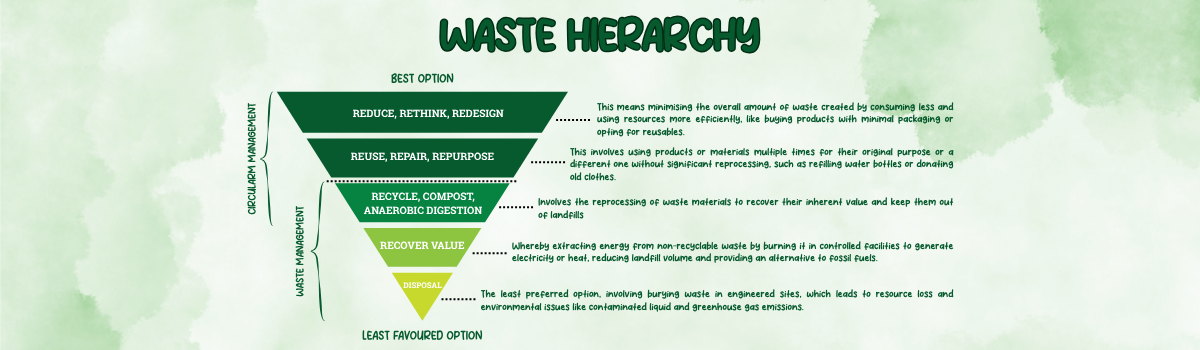
The waste hierarchy in NZ is a framework that helps prioritise how waste should be managed to achieve better environmental outcomes.
Rather than relying on a single solution, it focuses on reducing waste, reusing materials, recycling where possible, and improving how waste is handled at end-of-life.
Why the Waste Hierarchy Matters
Plastic plays an important role across packaging, logistics, and everyday use. However, how it is managed after use has a significant impact on long-term sustainability.
The waste hierarchy provides a structured approach to:
- Reduce unnecessary waste
- Extend product life where possible
- Improve recycling outcomes
- Address materials that still enter landfill
The Five Levels of the Waste Hierarchy
1. Reduce (Most Preferred)
Reducing waste is the most effective step. This involves minimising the amount of material used and improving efficiency in product design and packaging.
Where Biowrap fits:
High-performance materials can help reduce the amount of plastic required for certain applications, supporting more efficient use of resources.
2. Reuse
Reuse focuses on extending the life of products by using them multiple times before disposal.
Where Biowrap fits:
Biowrap products are designed to maintain performance during use, supporting practical reuse where applicable.
3. Recycle
Recycling allows materials to be processed and used again, keeping resources in circulation.
Where Biowrap fits:
Where facilities exist, Biowrap products can be recycled through soft plastic recycling streams. Recycling remains the preferred option before disposal.
4. Recover
Recovery involves extracting value from waste that cannot be reused or recycled, such as energy recovery or biological processes.
Where Biowrap fits:
In managed landfill environments, biodegradable materials may contribute to processes associated with anaerobic decomposition, including biogas generation where systems exist to capture it.
5. Dispose (Least Preferred)
Disposal is the final option and involves placing waste in landfill.
While necessary, it represents a loss of material value and is the least preferred outcome.
Where Biowrap fits:
Biowrap products are engineered to biodegrade in modern bioactive landfill environments through microbial processes under anaerobic conditions.
This provides an alternative pathway for materials that are not recycled, helping improve long-term waste outcomes.
A More Practical Approach to Plastic Waste
The waste hierarchy shows that no single solution solves the plastic waste problem.
Instead, a combination of approaches is required:
- Reduce where possible
- Reuse when practical
- Recycle where facilities exist
- Improve outcomes for landfill disposal, including materials designed for landfill biodegradable plastics
Learn More About Landfill Biodegradable Plastic
For a deeper understanding of how landfill biodegradable plastic works, explore the Biowrap eBook.
Explore Biowrap Products
Explore our range of landfill biodegradable plastic products designed for real-world use: